Amsterdam
Where the King Invites Me to His Birthday Party!


This is the second article in my travels to Europe. Check out my time chasing ghost Buffalo.

Before we dive in—tap the ❤️ if you’ve ever danced through a city and felt history echo underfoot.
A City Drenched in Orange
The king, Willem-Alexander, also invites millions of other people all over the Netherlands to his giant party. The streets of Amsterdam are wild with people, transforming the country’s Calvinist bent into a Hedonist one. The King’s Birthday used to be called the Queen’s Birthday—back when there was a Queen. There’s a King’s Night, too, but my friends and I were busy last night, solving the world’s problems from Brazilian, Dutch, and American perspectives instead of partying.
The next day, a Saturday, we begin celebrating at 10 a.m. with champagne. People everywhere clog the streets and canals of Amsterdam. The dress code is anything as long as it’s orange. I wonder whether a community-wide, live-and-let-live party is a jump-start to World Peace—or just a silly diversion?
The King’s Birthday means a throng of humanity in the streets, and the canals are clogged with boats. You could walk from one cobblestone street to the other by hopping across the party boats.
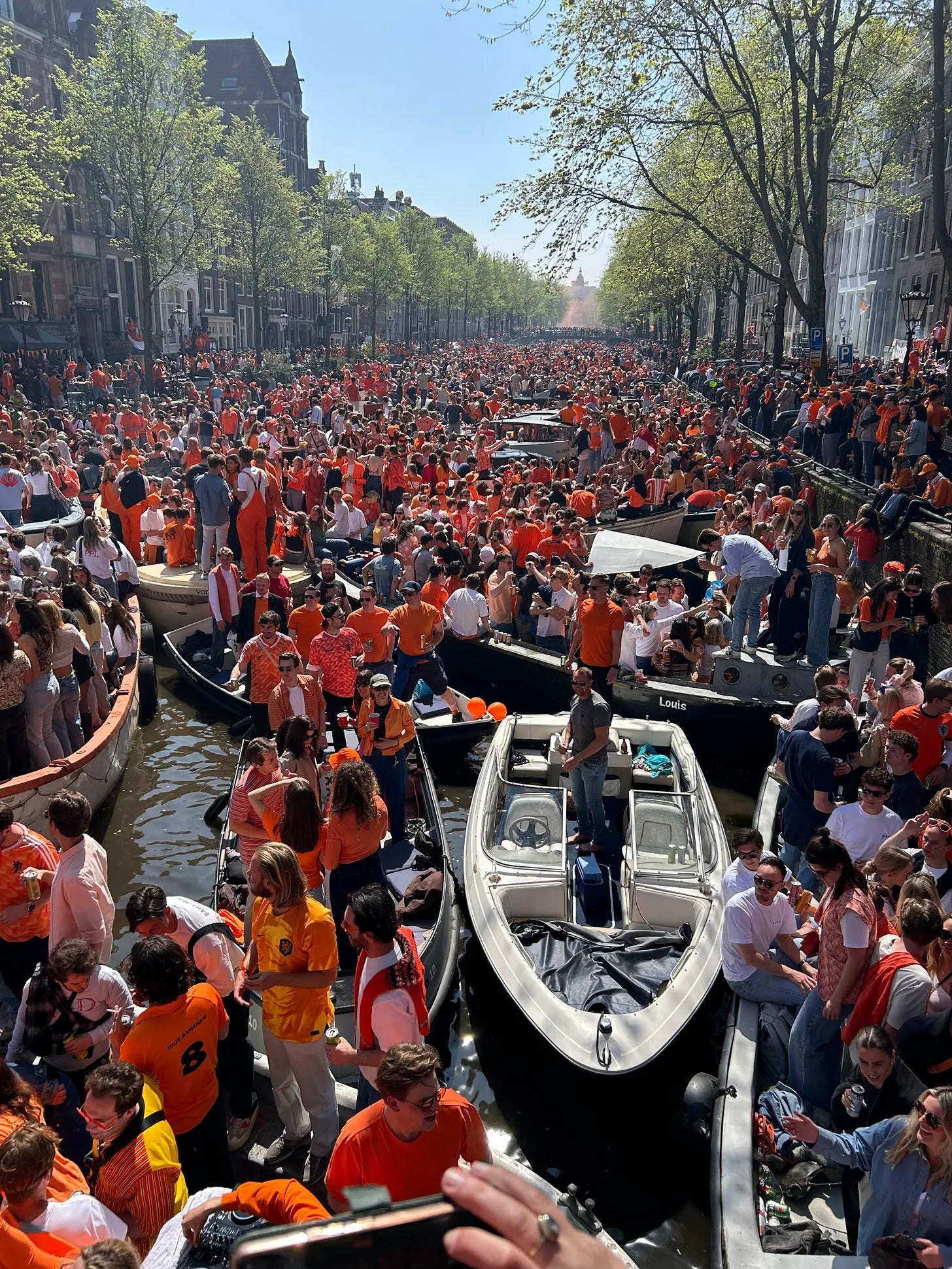
If our issues are all culturally, ecologically, and economically interwoven, the economic strand of the party is the street markets. Kids sell their outgrown toys. Merchants hawk vintage cameras.
One small girl is thrilled when my partner buys her colorful painting representing the four seasons. She and her friends twirl and giggle, Euros in their pockets. It’s international trade at its finest—and it’s easy to do business because the Dutch speak many languages before they even hit double digits. There is drinking, eating, dancing, pissing in the canal, and other games—such as toilet tossing. Yes, throwing actual toilets. (I don’t mean throwing up—that comes later.)
The real work of governance is done by elected ministers and such, so the king (and his queen) are busy kissing babies and playing games with the people who seem fond of the idea of monarchy. Why not? They throw good parties.
After our last stop, Paris—which I adored, though it is just so trop—the Dutch are a breath of fresh air. Here, healthy sturdy folk pedal across town, children in tow. If you get caught texting while biking, it’s a €200 fine. Today, all cars are forbidden, so there’s no drinking and driving. Guns have been banned in this country since the end of World War I. Imagine!
Big Shoes, Bigger Stories
I love thrift store shopping. There are plenty of those stores here—a kind of recycling. I spy the perfect shoes in a store window. Inside, a salesclerk in a beautiful dark suit brings me the shoes. I bemoan the fact that I have size 10 feet and it’s hard to find that size.
He says, “Dutch women have big feet, too.”
“Oh, of course!” I say. “That’s where I got them—from my father’s Dutch ancestors.”
A light goes on: yes, we are all related.
In return, I ask a version of the “Where are you from?” question, which nearly always elicits a migration story somewhere down the line.
He moves the perfect black suede heels aside and says, “My grandfather came here from Germany. He was a banker, a Jew who was well-connected enough that he could get out of Berlin as the Jews all had their rights taken away, one by one. He came to Amsterdam, where he bought a house. It’s still in our family. But then the Nazis invaded. The family hid in the cellar for three years,” he says, matter-of-factly, in that particularly Dutch way.
My brain reaches for the context of history. Just down the street is the much-touristed Anne Frank House, where she, too, was an onderduiker—a hider. More than 200,000 Dutch families, at terrifying risk, stepped in to hide and save others. Still, 75 percent of their Jews were killed. One of them was the fourteen-year-old Anne Frank. Generations still read her diary, which reminds us that the power of writing can feed our courage.
What We Inherit
This man in the beautiful suit tells me he fears our president and the growing division between Europe and the U.S.
“I don’t know what to tell my sons about the world,” he says.
“If they had to leave, where would they go?”
It’s the same question many Americans ask.
Back on the rainy street, I’m struck by a sudden urge to cry, and I don’t know why. Is it simple empathy? Or is it because if I can’t find a way to walk in someone else’s shoes, then sooner or later I will be forced to?
That’s because if history doesn’t repeat itself, at least it rhymes.
In the family history I am writing, I draw on my father’s own blow-by-blow account from Iwo Jima. Sooner or later, war returns, as if momentary peace were just an aberration. Maybe war is part of nature?
Yet we don’t just share the past—we also share the future.
I tell this story to Sky, Under One Sky’s Substack my man in Amsterdam, who also took the video from May 5—Dutch Remembrance Day, the day they honor their war dead and those who work for peace.
“The whole country stops,” he tells me. “They just meet in silence. If you are in a store, and talking, someone will come over and shush you. You must remember.”
I hold that phrase—“You must remember”—in my heart.
Celebration as Party and Protest
King’s Day is a chance to put the bigger questions aside for a moment and just love our neighbor as ourselves—albeit in a culturally generated, huge party. And for a moment, we put so-called politics aside as well.
But politics are never really politics.
They are our values.
And those values shape our lives every day.
I am out of answers.
Soon enough, though, on June 14 our own president is throwing a giant birthday party for himself. Sorry—I meant there will be a giant commemoration in Washington of our country’s 250-year-old army.
“We have the greatest weapons in the world—and we should celebrate it,”
says he who would be king.
As if there is only one kind of power.
But the power of people coming together remains.
All over the U.S.A there will be “No King’s Day” gatherings to protest growing authoritarianism.
I hope it will be a hell of a party.
What Comes Next?
I’m considering writing next about:
Free Speech
Duty
Celebration
Which one would you read first? Drop it in the comments. This isn’t a monologue—it’s a living dialogue.
📚 Inspired by Fellow Travelers & Writers
This piece was inspired, in part, by the reflections and work of fellow Substack writers exploring history, culture, environment and memory:
— on King’s Day and Dutch national identity — on remembrance, ritual, and European reflection – offers data-driven independent journalism on climate and biodiversity progress from around the world. — on the layered landscapes of travel and transformation So There’s This Place — for evoking place as character and emotional geography
Looks like King’s Day in the canals! I used to have a houseboat on the Prinsengracht in the late 60ties; those were the days of resistance and change that worked. Now I’m not so sure any more. Amsterdam may look great to you, but the real glory of the city has been usurped by tourists and drunken party goers. There is history here as you said, and there is more to this city than any tourist can figure out.
My vote is FREE SPEACH