KIN
What survives of us in a place, and what of the place survives in us?

Tap the heart ❤️ if you’ve ever returned home to find it both exactly the same—and completely changed.

My new Substack continues on from Margaret’s Girl.
The Sky, the Soil, and the Steam
Where I come from, the sky is more enormous than anywhere, because this place is the flattest place on earth. It presses down on the land like a long-held silence. Perhaps I’ve been holding my breath for far too long. It’s not really comfort I’ve come for, but something more ambiguous.
Obligation? No. Connection.
The earth seems to remember my name, perhaps because the bones of most of my ancestors have piled up around here. And in my father’s birthplace of Andover, South Dakota (pop. 55), the wind tells stories no one else will. It’s here I have come to pretend that there was once a simpler time. The reason for the season is the James River Valley Threshing Festival, a place where people have been bound to the soil by something deeper than choice. We are bound by accident of birth. Here are most of my kin.
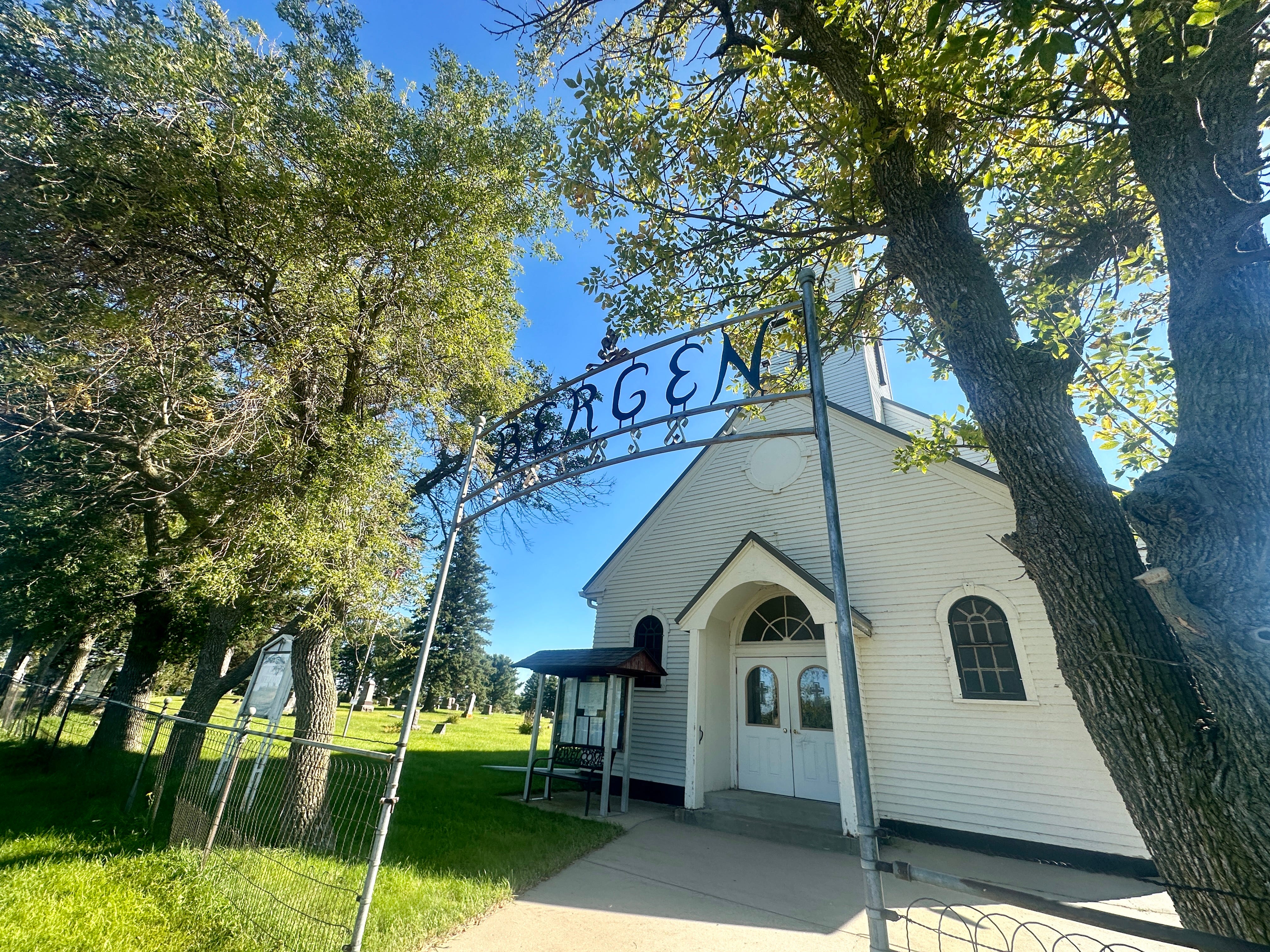
Thresherman’s Field is its own way-back machine: there’s an old gas station, machinery parades, quilting and weaving exhibitions, the Feed Bag (pretty good hot dish), the Bergen Church ice cream stand, an old one-room schoolhouse (my father went here), and a little white church (my cousin’s husband preaches).
The first person I see is Kory Anderson, the 35-year-old Rock Star of steam tractors. He was born into a family that lived next door to my grandmother, and they’ve promoted this living history for fifty years now.
As a kid, Kory also dreamed about a legendary steam-driven tractor, the Case 150. Only six were ever made. Back in 1905, the same year my Norwegian grandmother arrived here, and like the dinosaurs, they all died out. He discovered a leg bone, I mean, a tractor part, in a New Mexico mine. He became passionate about breathing life again into it and resurrecting the past from that one part. It took a million dollars or two, if you count the foundry he bought to make the rest of the parts.
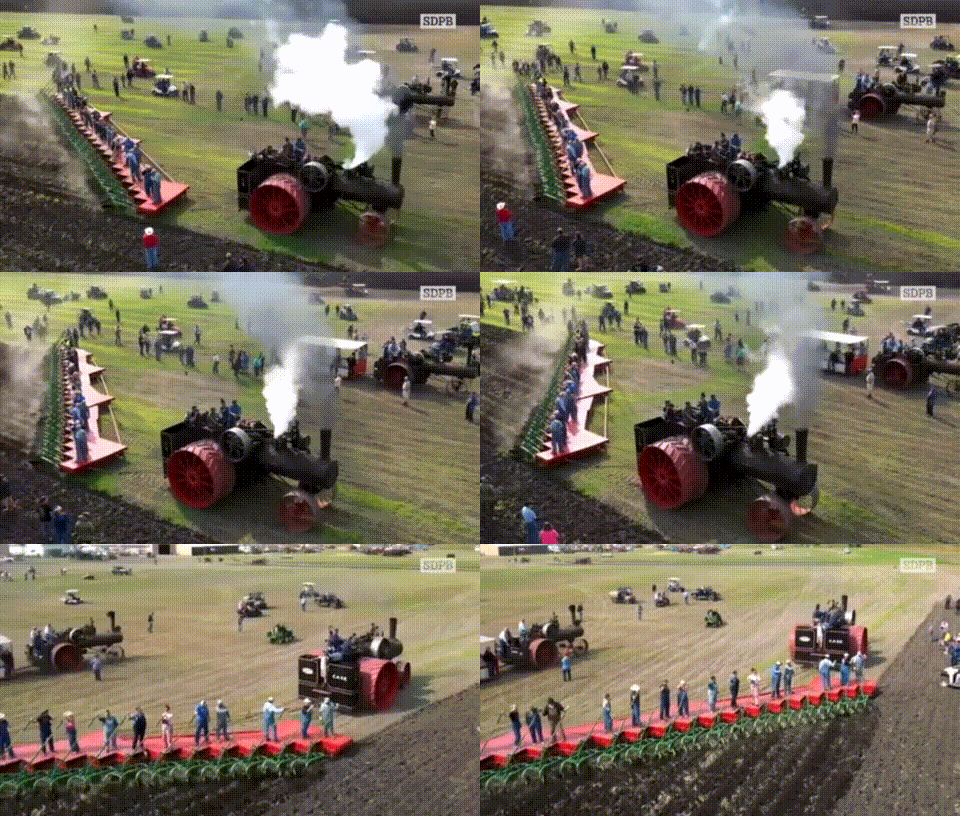
What he preserved wasn’t just a machine. He created a future by protecting the jobs of his friends at the foundry and by resurrecting community and a love for farming. He has a Guinness World Record for owning the biggest steam tractor in the world. But that’s not the point. He’s a purveyor of vision. Now, every time I wonder why I’m still writing this epic book, drawn from the same roots and motivations as his, I envision that tractor. And I take heart.
That 75,000-pound fire-breathing dragon resurrected a desire in me, too, not so much to get an old life back, but to integrate the person I’ve become. Here, among relatives and tourists, we watch black smoke rise into that memorably huge sky and watch the fire build in the belly of the beast. When the fire gets hot enough, it inches along (like my book). What it pulls behind it is a platform of people who, like synchronized swimmers, lower plows into the earth. Along with little wanna-be-farmer boys and flocks of tourists, we follow along, mesmerized, as the tractor turns the richest earth on earth into glistening chunks like coal.
This miraculous prairie still grows crops to feed us all.
Cradle to Grave
In my adoptive home of Taos, New Mexico, it’s the mountains and the Taos Pueblo that keep me grounded. But it’s this place that has driven me to love community, now, in a place where the dense weave of nature/culture suits who I’ve become. The Dakotas, too, have changed. One cousin teaches English as a second language to immigrant kids in my formerly white bread grade school.
In the nearby town of Langford (pop. 250), my father met my then 16-year-old mother on Main Street and decided to marry her. Today, I walk across the empty street at 6:30 a.m. to the only place for coffee, the gas station. The sunrise comes sharp and certain, like it knows to set at the end of Main Street when the day’s stories are done. The tallest things on the horizon are church steeples and grain elevators.
The small family farms of childhood have become corporate agribusiness. The farm, now a corporation, of my Scandinavian cousins covers over 1,000 acres, which is about average for these parts. They have stayed put.
The first of my father’s side was a great-grandfather who left Illinois, hoping to outpace a tuberculosis death sentence. He built a sod house, proved up on his allotted blank acres, and sold farm implements in the newly platted town of Andover. My father’s people mostly left for bigger things in bigger places, like Minneapolis. But my cousin Linda, who still has the family farm, has not missed a Threshing Festival in fifty years, and this year is no different. With me in tow, they drive back from Minneapolis.
When we got here, my mother’s cousin Diane had predictably peeled 10 pounds of potatoes and invited about 28 relatives from both sides for a welcome-back supper. The next day, we drive through the countryside. She’s a lay preacher at many of the small country churches and the unofficial matriarch of town, having known everyone around from cradle to grave, including me.
We scare up a few pheasants, pass places where I learned to swim and skate, and roll past fields of green corn, or soybeans, take your pick.
Most of the supernatural yield now comes from Bayer Corp, the world’s biggest purveyor of agrichemicals like Roundup and genetically modified seeds. They bought out Monsanto and changed the name to protect the guilty. Or, if you’re a farmer here, you just appreciate the yield, because profitability is what keeps farmers farming. The weather still seems to be in the hands of an unpredictable God, who has been provident with rain this year and sparing of blizzards and tornadoes.
Keeping the Faith
One night, I find myself at Remedy’s—the one restaurant still sometimes open, surrounded by cousins and a nearby table of young South African farmworkers. Also, there’s a new Moral Sheriff in town: the incoming Lutheran minister.
Yet ministering to a community isn’t about being the moral police; it’s about tending to people’s lives. It’s also about building community, perhaps the way Kory’s giant tractor does.
How can he follow in the footsteps of my cousin? She stays up late baking pies and Kringle (a Norwegian specialty) for church suppers? I wonder if he’ll be baking much.
Beer in hand, I introduce myself. I’m curious, too. How might this newly single, fifty-something Californian adapt to a small Dakota town? Our conversation soon pivots to another universe: that of jazz bars in Lower Manhattan.
“You know the Blue Note?” I ask.
He does. Then brings up Smalls, which I know too, but he’s reached the extent of my knowledge of that world.
My farmer cousin leans over:
“Where are you guys talking about?”
“New York,” I say.
As I get up to leave, the preacher points to my handbag.
“Coach?” he asks.
Flustered, because I dunno, it’s just a bag, I say, “Yeah.”
He corrects me: “Nope. Kate Spade.”
I wonder about so many paradoxes. Where I come from is like this, like every place. Sometimes we’re open-hearted and closed-minded.
On Sunday, I ask my cousin how any of us can sing our hymns and pray our prayers and not see what’s happening in our authoritarian and self-protective, self-righteous country. Will the preacher man preach the difference between Christians and Christian Nationalists? And as they (predominantly women) keep cooking, keep quilting, will they also speak out? The culture I grew up in didn’t do that, which is why I write these days.
Here, I can stand on a Budweiser can and see forever. But I can no longer see where we’re all going. I think the preacher man will do just fine.
Sometimes going back is the start of moving forward.
Tell me in the comments (I read and respond to every one): What kinship still holds when everything else seems to change?
James, thank you! YOU are the writer here! Thanks for the tribute and the reminder to always look for beauty!
Being connected to place and people is something we all long for. Our world is changing so quickly but roots that run deep remain. Thanks for the reminder.